Tarpaulin closed compartment
Last reviewed version: 2.22Prerequisites
The tutorial presents a simple case study with the purpose of demonstrating functionality in AquaSim.
It is assumed that the user is familiar with the basic principles of modelling and specifying material parameters in AquaEdit, as well as conducting analyses. If you are looking for an introduction to AquaSim we advise you to start with the Basic program tutorials.
Learning objectives
In this tutorial, you will be introduced to how establish and analyse static equilibrium of a hemispherical shaped tarpaulin attached to a floater. This includes the following steps:
- Modelling of a hemispherical tarpaulin closed compartment.
- Analysis of equilibrium in seawater.
- Analysis of equilibrium in brackish water.
- Analysis of equilibrium with fresh water.
Introduction
Checking static equilibrium is important to ensure the model is stable and correctly set up. More specifically:
- Balance internal- and external forces: in water, structures are subject to buoyancy, gravity, hydrostatic pressure, tension from mooring etc. These forces must be balanced out to so that the model does not accelerate or rotate.
- Correct boundary conditions: if equilibrium is not satisfied, it often means that there is something wrong with the boundary conditions. This may be ill defined mass distribution, lack of buoyancy, wrong fluid density and so on.
- Numerical stability: having balanced the internal- and external forces and correct boundary conditions, this facilitates numerical stability in further analyses.
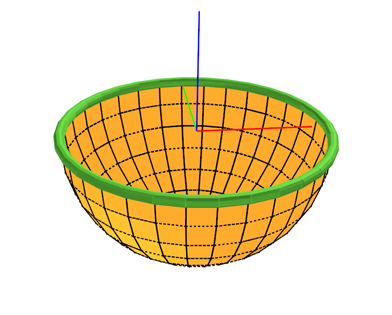
When assessing static equilibrium for closed compartments, some key parameters are considered. In this tutorial it involves:
- Control of waterline level for the fluid inside the compartment. This is often referred to as “internal waterline”.
- Control of relative pressure between fluid inside- and outside the compartment.
- Control of how fluid density affects the model’s floating position.