Brackish water
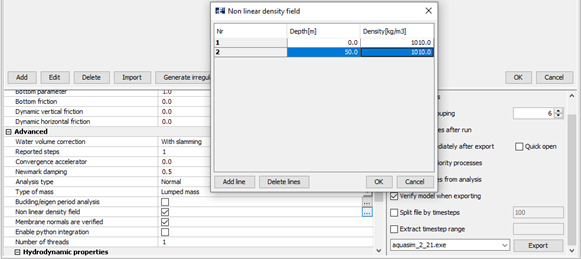
Last reviewed version: 2.22Now we introduce brackish water on the outside of the tarpaulin closed compartment. This parameter is found in Export > Non linear density field, see Figure 22. Fluid density for brackish water is assumed 1010 kg/m3.
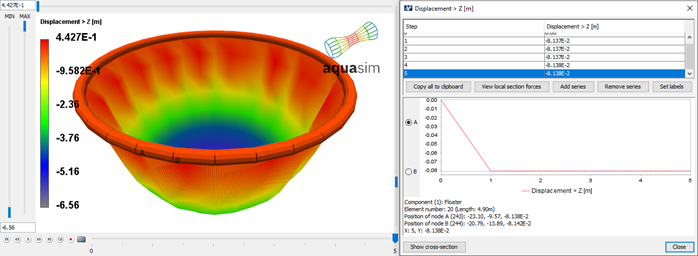
A fluid density of 1025kg/m3 is kept on the inside of the tarpaulin. Having analyzed static equilibrium, we see that the floater moves approximately 8 cm downwards. This is seen in Figure 23, where one also can see the bottom of the tarpaulin displaced downwards.
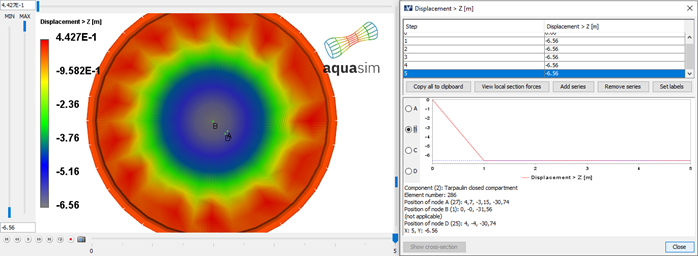
The bottom of the tarpaulin, Figure 24, displace about 6.5 meters downwards.
At equilibrium, the inner waterline is about 15.9 cm below the mean water surface, see Figure 25.
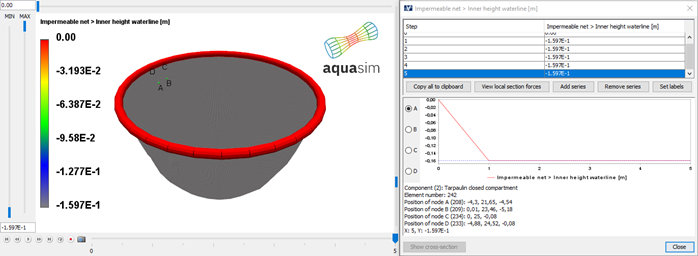
This means that if you would like to have the inner waterline above the outer waterline, you will have to introduce more water to the system.
The relative pressure between the outside- and inside water is shown in Figure 26.
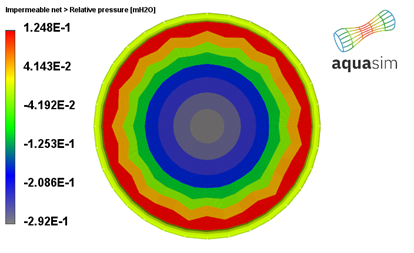
As seen from Figure 26there is a net pressure inward in the upper part of the tarpaulin, and net pressure outwards in the lower part.
As seen from the figures in this section, brackish water means more weight needs to be carried by the floater. Intuitively, there is a risk by having the inner waterline below the outer: rainfall or waves pouring more water into the tarpaulin closed compartment will increase the weight carried by the floater. Eventually one risks the structure to sink. One must be able to transport excess water out of the enclosed volume. Systems may have valves in the bottom area, in this case with brackish water it may be a good choice to have valves closed to the bottom in cases where the outer density is lower on the outside compared to inside the volume as there is higher pressure on the inside in this area as seen in Figure 26.