The hybrid load formulation
Last reviewed version: 2.22The hybrid load formulation is applied for calculation of wave excitation loads by combining two load formulations. Two hybrid options are available:
- Hybrid flexible tarp/ Numerical diffraction: combines the Flexible tarp method with the Numerical diffraction.
- Hybrid flexible tarp/ MacCamy-Fuchs: combines the Flexible tarp method with the MacCamy-Fucs.
Both hybrid methods work with the same principle: the wave excitation loads are calculated as a weighted combination of the two load formulations. The weighting, or scaling, is defined through the factor “Diffraction scaling” in AquaSim. For example, selecting Hybrid flexible tarp/ numerical diffraction with a “Diffraction scaling” factor of 0.25 imply:
- 75% of wave excitation loads are found from the “Flexible tarp” method.
- 25% wave excitation loads are found from the “Numerical diffraction” method.
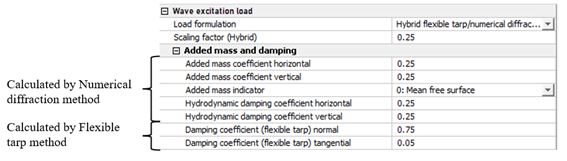
The same relation is applied for radiation loads (added mass and damping) in AquaEdit. That is, if diffraction scaling is 0.25 then added mass- and hydrodynamic damping coefficients will be 0.25. The damping coefficients (flexible tarp) will be 0.75. This is illustrated in Figure 20.
So, when is the hybrid load formulation useful? The hybrid method is useful when having, for example, semi-rigid or moderately deformable structures. As the pure “Flexible tarp” method does not account for diffraction terms, applying this would lead to underprediction of forces. While “Numerical diffraction” also accounts for scattering of waves (i.e. diffraction term), this method alone could overpredict the forces. The hybrid method will then account for damping and hydroelasticity from “Flexible tarp”, and at the same time include partial diffraction effects from “Numerical diffraction”.