Predator net
Last reviewed version: 2.22
Introduction
Prerequisites
Familiarity with the Component contact: Falling box (Aquastructures, 2026a) tutorial is recommended, as the present tutorial builds on the same contact principles.
Learning objectives
Upon completion of this case study, you will be able to:
- Model a predator net surrounding an aquaculture fish cage
- Establish a Component contact-table between the predator net and the fish cage net
- Understand how contact forces are transferred between two flexible net structures
- Define appropriate contact parameters including stiffness, damping, and contact distance
- Execute a dynamic analysis involving component contact
- Evaluate contact forces and structural response in AquaView
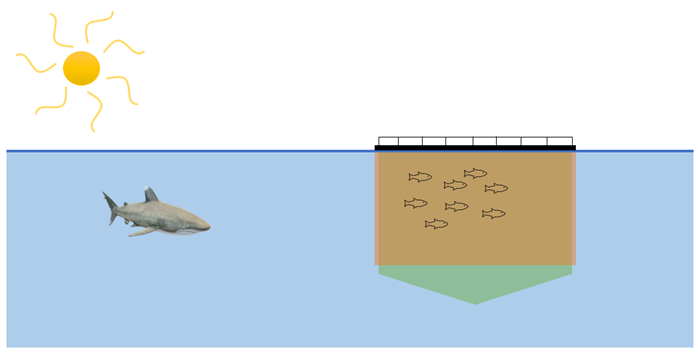
Figure 1
The marine predator may be any marine mammal, but can of course also be any objects such as lumber, boats, drones, ROVs, or torpedoes / missiles. This case study considers a net in water but also nets in air may be considered as the case shown in Figure 2.
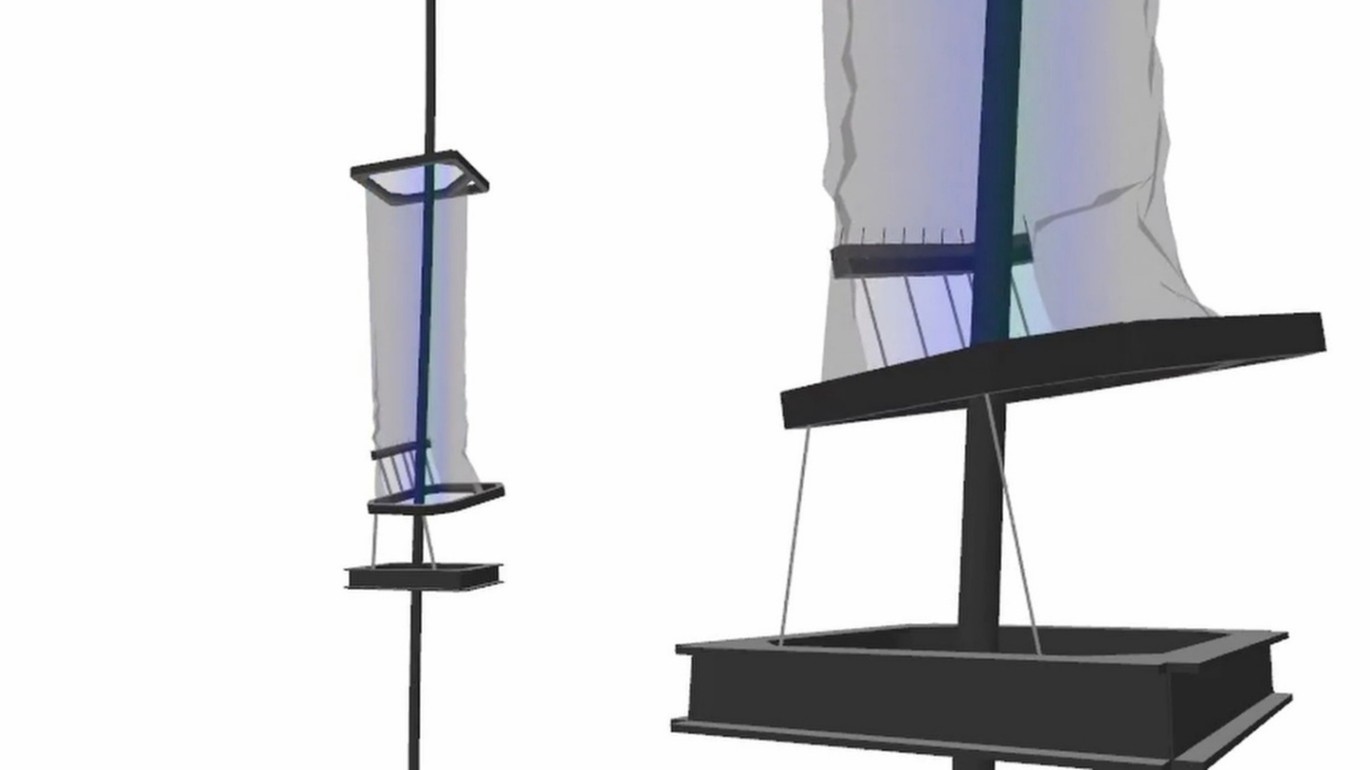
Figure 2 Safety net simulation (Aquastructures, 2026b)
Predator nets are commonly used in aquaculture to protect fish cages from marine predators such as seals and sea lions. The predator net is typically a coarse, stiff outer net structure installed at a distance surrounding the main fish cage net. Under environmental loading from currents and waves, both the fish cage net and the predator net will deflect. In severe conditions, the two net structures may come into contact with one another — a situation that must be accounted for in the structural analysis to ensure neither net is overloaded.
This tutorial describes how contact between the predator and the fish cage net can be modelled and analyzed in AquaSim using the Component contact functionality. The basic principle is to define contact between two component groups (in this case the predator and the cage net) and specify the parameters governing the contact response. AquaSim tracks the relative position between the two component groups at every time step throughout the analysis. When elements from one component group approach elements from the other to within the specified contact distance, a repulsive contact force is activated.
The contact-force F is related to the contact spring stiffness k and the relative displacement r between the elements by:
\(F = k \cdot r^5\)
This nonlinear relationship means that the contact force increases rapidly as the two nets are pressed together, which is physically consistent with the behavior of flexible net structures in contact.